
King Fahd University of Petroleum & Minerals
College of Computing and Mathematics
MATH102: Calculus II
Core chapter notes, course policy highlights, and textbook information for Calculus II. Use the chapter cards below to go directly to the main content.
Chapter Notes
The chapter links are the primary navigation for the course notes.
Textbook
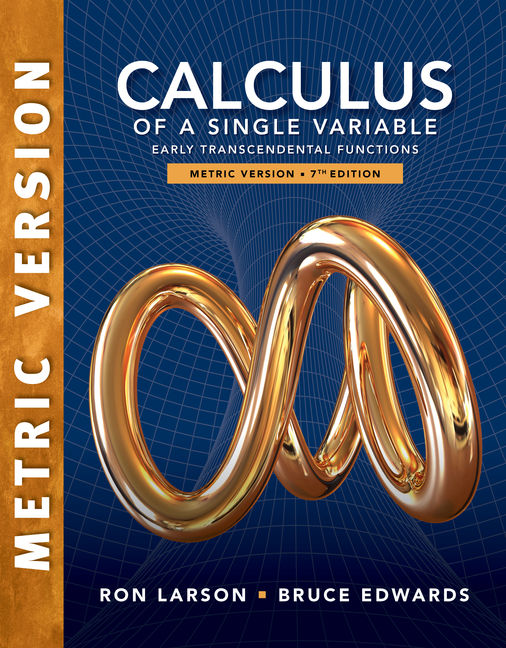
The course follows the official syllabus text and chapter sequencing from the adopted Calculus II textbook.
Larson, R. & Edwards, B., Calculus: Early Transcendental Functions, Metric Version, 7th edition, Cengage Learning, Inc., 2019.
Learning Outcomes
Based on the course syllabus.
- Estimate areas and definite integrals by Riemann sums.
- Apply the Fundamental Theorem of Calculus.
- Evaluate integrals using various techniques of integration.
- Calculate the average value of a function, areas between curves, length of curves, volumes and surface areas of solids of revolutions.
- Evaluate improper integrals and limits of sequences.
- Apply convergence tests of series and evaluate sum of some selected convergent series.
- Find interval and radius of convergence of a power series and express a function as a power series (Taylor and Maclaurin).
Grading Policy
Summary of the syllabus grading weights and the class work normalization rule.
- Exam I70/300 (23.33%)
- Exam II70/300 (23.33%)
- Final Exam100/300 (33.34%)
- Lab Python30/300 (10%)
- Class Work30/300 (10%)
Class Work Formula
y = 3 * (median(Exam I %) + median(Exam II %)) / 20
Expected interval: [y - 1, y + 1]
Course Description
Definite and indefinite integrals of functions of a single variable. Fundamental Theorem of Calculus. Techniques of integration. Hyperbolic functions. Applications of the definite integral to area, volume, arc length and surface area. Improper integrals. Sequences and series: convergence tests, integral, comparison, ratio and root tests. Alternating series. Absolute and conditional convergence. Power series. Taylor and Maclaurin series.